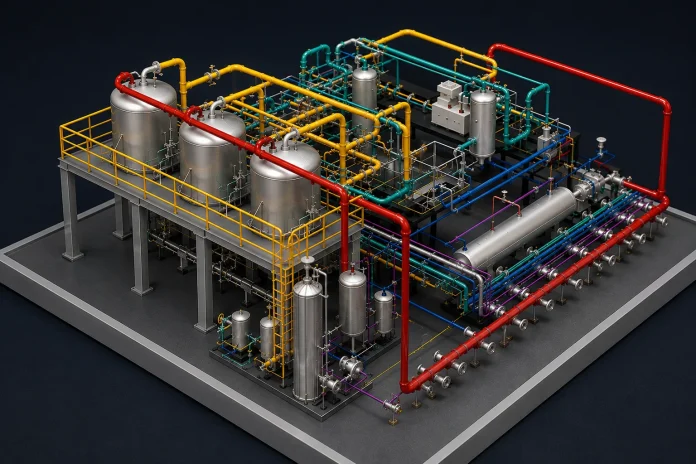
Commissioning a scaled replica of a pipe network is a small project with big consequences. Get it right, and you have something that helps design reviews, training and client visits for years. Get it wrong, and you have an expensive object that shows the wrong routes, lacks the details your team needs, or arrives cracked in a crate.
Most of the difference comes down to who you hire and how well you brief them. If you’re about to approach a piping model making company, this guide will help you go in prepared, and come out with a result you’re happy to show off.
First, get your own house in order
Before you contact anyone, work out what the replica is for. Design review? Operator training? A tender presentation? A permanent display at the plant entrance? The purpose shapes everything else: scale, detail, materials and budget.
Then decide the boundaries. Which units or areas should be included? Does the model need to show the whole plot, or just a critical section? Not every line needs to appear. Leaving out minor utility lines might keep the model clean and affordable, while including every small-bore drain might be essential for a maintenance-focused piece.
Finally, appoint someone from your team to be the main contact. Nothing slows a project like five people sending different feedback, each contradicting the last, to a workshop that has to guess which version is correct.
Gather the right information
Makers can only be as accurate as the data you provide. Typically, that means plot plans, general arrangement drawings, piping layouts, equipment lists and structural drawings. If you have three-dimensional design files, share them. They give the maker a clear view of routes and elevations, and reduce guesswork.
Also share any labelling requirements: tag numbers, colour schemes, legends. If you want service colours to match your plant standards, say so at the start.
If some documents aren’t final, say that as well. A good maker would rather hear about pending revisions upfront than discover them after cutting pipe.
What to look for in a maker
Experience with process plants is the biggest factor. Reading a piping layout is a skill in itself, and someone who has done it many times will spot problems that a general model builder won’t. Ask about previous work in refineries, chemical plants, power stations or similar environments. Ask what happened when drawings were incomplete or contradictory, and how they resolved it.
Workshop capability matters too. Do they cut and assemble in-house, or subcontract? Do they have the equipment to produce clean, consistent parts? A tour of the workshop, even a virtual one, tells you more than any brochure.
Then look at the team. Do they include people who understand engineering drawings? Can they discuss valve types, supports and equipment orientation confidently? You’ll be working with them for weeks, so their communication style matters as much as their technical skills.
Reading quotations properly
Quotes vary, and price is only part of the story. Compare what’s included: scale and dimensions, level of detail, materials, base, labelling, packing, transport and installation. Ask how many revisions are covered and what happens if your drawings change midway through.
Cost is mainly driven by the number of lines, the density of equipment, the scale and the finish. A compact model with hundreds of small pipes can cost more than a larger one with fewer, simpler runs. If two quotes differ hugely, ask why. The answer will tell you a lot.
Be wary of anyone who won’t put scope in writing. Vague quotes lead to arguments later.
Payment terms deserve a look as well. A sensible arrangement ties payments to progress: an advance to start work, a further instalment when the main structure is complete, and the balance on delivery and handover. It protects both sides. You’re not paying for work that hasn’t happened, and the maker isn’t carrying the whole cost of materials on trust. If a company resists any kind of staged arrangement, ask them to explain their reasoning.
Milestones, approvals and who does what
A realistic schedule includes checkpoints. A serious maker will suggest review points, perhaps after the base and main equipment are placed, after the main pipe routes are fitted, and before painting and labelling. At each stage, ask for photographs or a short video. Catching a misplaced pump at the early stage is much better than after everything’s been glued down.
Also ask about your role. Deadlines slip most often when clients are slow to approve drawings or answer questions. Agree on response times and stick to them.
Getting it to site in one piece
A finished replica can be delicate, with hundreds of thin pipes, small valves and tall columns sticking out. Ask about packaging. A custom crate with cut-out supports is the safest route, especially for long distances. Clarify who carries the transport risk, and whether insurance is included.
Installation should be part of the conversation. Will the maker’s team assemble and position it on site? Do they check that everything is level and undamaged? It’s often worth having them present at the handover to answer questions and show your team how to look after it.
Afterwards, find out about support. Parts get knocked off, plants get modified and models need updating. A maker willing to help later is a maker who believes in the work.
When to walk away
Step back if a company can’t point to any process-plant work, names a delivery date before it has even seen your drawings, or quotes a fixed price without asking a single question about line count or equipment. Also be cautious of anyone who treats your project as generic craft work and can’t discuss the process side. In this field, understanding plant layouts matters as much as manual skill.
Running a fair comparison
Contact three or four makers with the same brief and the same set of drawings, so you can compare like with like. Speak to their references, and if the project is big enough, ask for a small sample section. When you’re comparing options, consider how an experienced piping model making company approaches the job, then hold everyone else to that standard.
Final thoughts
A replica of your plant is only as good as the people who build it and the information they’re given. Spend time on your brief, be open about what’s uncertain, and treat the quotation as a conversation rather than a price tag. Hire well, and your piping model making company will do its job quietly for years: helping people understand, plan and work safely around the real thing.
